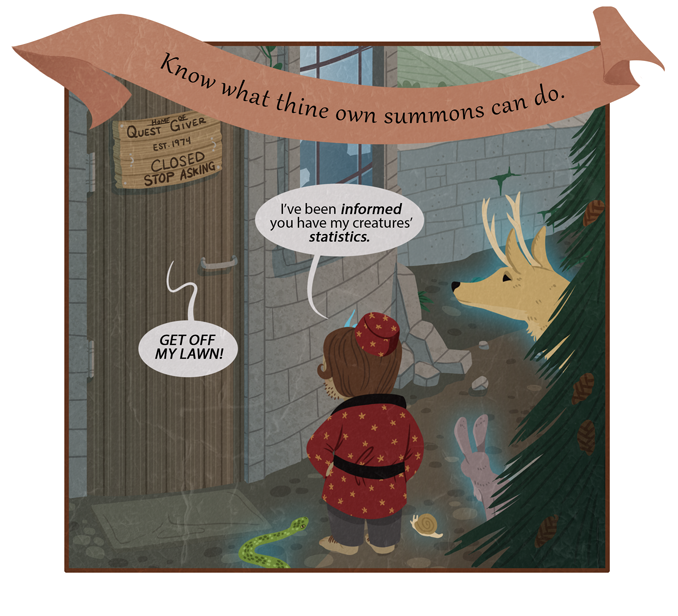


Conjure Stats
Between Friday’s wolves and today’s assortment of forest critters, it’s clear I’ve got conjuration on my mind. And for those of you who have never conjured woodland beings before, let me point you toward this tricky little line at the end of the rules text: “The DM has the creatures’ statistics.” To illustrate why that line might be controversial, allow to me to quote Matthew Mercer and Sam Riegel from Critical Role, Campaign 1, Episode 49. Ahem:
Mercer: “I hate conjuration spells, by the way, guys. Just so you all know.”
Riegel: “To be fair to Marisha, the spell does say ‘Your DM will have a list of the creatures—’”
Mercer: “Does it really?”
Riegel: “It does, at the end of the—”
Mercer: “Fuck that spell. Conjurations can die. No; conjuration’s great… when you’re not the DM.”
The idea of halting your exciting combat encounter to consult pages worth of monster stats is obnoxious on its face. Back in my day, I always made sure to have my own statblocks printed out and ready to go. This was all about the more general advice of “know what your spells do,” and was about good player behavior. The idea is to offload some rules responsibility from the GM, helping out with the flow of play.
That said, it’s easy to understand why the GM has the statistics. Unlike the baroque rules of Pathfinder that make sure to list curated creature summons at every level, 5e assumes that it’s the GM who picks the creature. There’s good reason for this. The old power gamer move of conjure woodland beings > choose pixies > order the pixes to polymorph everyone into a T-Rex is plainly game breaking. It’s much easier to point at the guy behind the screen, tell them that they have the freedom to run the game however they like, and then bury ’em beneath a pile of paperwork. This is called “game balance.” It is also called, “How to piss off Matt Mercer.”
So for today’s discussion, what do you say we come up with some better solutions? When your players choose to add a “conjure” spell to their spellbook, how do you divide up the creature stat responsibilities? Should you ask your players to make up some favorite monsters ahead of time? Homebrew your own setting-appropriate minions? Or do you simply throw up your hands and let the pixies do their thing? Whatever your answer, let’s hear all about it down in today’s comments!
JOIN THE HANDBOOK OF HEROES DISCORD! Do you want a place to game with your fellow Heroes? How about a magical land where you can post your dankest nerd memes, behold the finest in gamer dog and geek cats, or speculate baselessly on Handbook of Heroes plot developments? Then have I got a Discord Invite for you!

I run a Pathfinder game that has a Druid in it, and I have informed the player that if he is intending to use his Summon Nature’s Ally he has to give me at least 1 week of advance warning so I can make the character sheet. We play online.
Why doesn’t the druid take care of it himself? Is it a lack of expertise or software or something?
Roll20 is only lets GMs make character sheets even if the players can edit them, and I generally have more free time than the player does.
Gotcha! And you do everything in-app? That makes sense then.
There’s actually an option in the game settings to allow players to make their own character sheets.
There is? I’ll have to look into that. I’d assumed that they’d got rid of the option.
This is one place where I prefer the curated list of dnd 3.5/pathfinder 1e to 5e’s going with all CR x or less creatures in the category and then shifting both work and blame to the GM.
Or for that matter PF2’s “all CR x or less creatures in the category except they actually thought about that when designing them and just to be safe summoned monsters can’t cast spells/spell-likes of a higher level than the spell used to summon them.”
The important bit is that the players need to be able to handle their stats themselves.
As a GM I also demand that they have them ready if they want to do summoning.
As a bonus allowing the players to pick the summoned creature also means that they can use the spell for interesting problem solving outside of just summoning extra combat muscle.
Summoning a hound to smell which tunnel someone went down, work very well if you might get a bird instead.
The other style of 5e summoning spell where the spell makes a completely new statblock is also OK, but costs the aesthetic pleasure of summoning a creature that actually exists in the world. That’s better for shaping a dream or elemental out of magical essence and similar tricks IMO.
This is why I was surprised to learn that 5e does not let you pick. The possibility of hoping for sharks only to receive a school of “””helpful””” guppies is a major turn-off from the player side. I’ve never met a GM that would actually do that, but the possibility would bother me.
I have to damit, I prefer Pathfinder here. Yeah, the GM might have to hit some stuff with the ban-hammer, but you know what you are getting. In fact with the lists beeing that much smaller its pretty easy to ensure no OP stuff goes there.
If thats not the Case, its easy and allows the Players to use the spells much more creativly.
Is “1d3+1 succubi all Spam dominate” OP? Yes, but so is “quickened ill omen + dominate”. My point beeing that short of the actual Summoner I found very few cases where this Player controlled system of summons is particularly potent nor do I find the Change to 5th Version necessary
One interesting note in the Pathfinder version is the explicit ban on summoned creatures using summons of their own:
“A summoned creature cannot use any innate summoning abilities it may have.”
I guess that one came up explicitly in play test. :/
I just don’t summon or raise dead in systems without discreet stat blocks for the things attached to the spells themselves.
Love me some 13th Age for that, it’s the only game I’ve ever felt good about being a necromancer in.
Then please enjoy my favorite necromancy song.
https://www.youtube.com/watch?v=0RVeo79yfw0
We currently have a summon happy druid in our 5e game (run on a vtt), and the gm provided him with a list of pre-approved summons that are set up and ready to go. If he wants anything else the GM reserves the right to say no, which is more likely if it happens during the game rather than some time before it.
Is anything straight up banned from the list?
Arcane (or Divine) summons are great to have when you’re preparing to book it from a losing encounter or being hotly pursued by a monster. My spellcasters routinely name theirs ‘chaff’ and ‘flare’. 🙂
That’s magically created summons, not familiars or animal companions, although in a pinch… 😉
There’s a reason Menchi is named Menchi.
https://youtu.be/vuel3m5VFQA?si=ykh83TLLRqBwilMr&t=19
just a note to point out that another reason (possibly) for having the stats and choice be up to the DM is flavor of setting and situation.
You conjure some animal friends and choose bears… in the middle of the ocean?
Or sharks under ground. How about some penguins in the jungle or some camels in the arctic.
Obviously these seem like silly choices that no one would make right? Except because people are people, the simple facts are that some one somewhere has definitely made exactly one of those choices in a game at a table where a DM said “No, you can’t do that.” and a rules lawyer of a player said, “Yes I can, the rules say so.” and an argument turned into a fight and a table broke up over the stupidity of it all.
So new rules were made… that make Matt Mercer (and more than a few DMs out there) mad.
I think there is not, never will be, and never has been good rules for conjuration, because honestly, even as a player that could make good use of breaking some of those rules, conjuration/summoning SUCKS!
It is great in a story for the reasons of magic that make those spells amazing, but in practice it is so dang complicated that one can even forgive the DM that outright bans those spells from their table (yep, those DMs are not that rare either).
If you want even more examples of how broken conjuration magics are, just watch The Seven (Dimension 20) and the summoning of geese…
For our personal table, the DM definitely doesn’t keep stats on hand and fortunately DnDBeyond is fairly easy to search that stuff out.
Tho that brings up yet another reason “the DM has those stats” – because maybe your DM doesn’t want players to know stats of any monsters for whatever reasons.
Ugh, I don’t even play summoners and have hardly ever dealt with this kind of stuff and I am getting a headache just thinking about it!
I agree with Matt Mercer. Conjuration magic SUCKS!
I feel like penguins in a desert fall under the “tolerance for shenanigans” clause we mentioned in the previous conjuration comic. But tolerance for rules lawyers? That’s always set to zero. 😀
Wait, people can evoke schoolbus-sized balls of fire under water, create food and water from thin air and yet it’s terrain-inappropriate animals that break verisimilitude?
That sounds like a “them” problem not a game problem.
My route has usually been something like “lemme know if you’re gonna take/use that spell,” then, especially for Druids, handing them a stat block. “Here’s ‘Eagle, giant’ and ‘Wolf, dire.’ They are your default critters. If you want something fancier than that, you do the work yourself ahead of time or be prepared for whatever you summon to use the exact same stats, regardless of its species or plane of origin. Have a nice day.”
Then again, when I was 10, playing the game in a friend’s basement, I had my 3″x5″ notecards handy for my Druid’s shapeshifting based on my National Geographic collector’s cards. “Wait,” I’d say, holding ‘cheetah’ and ‘peregrine falcon’. “Do we need land-speed or flight speed?”
I like the idea of stat cards for different forms. The prospect of redoing them at every level in 3.X always put me off of the strat though.
I’ve only been familiar with 3.5/Pathfinder summoning list system and didn’t know this was a possibility.
Definitely should have pre-approved list of summonable creatures before the game to avoid interrupting the game. There should be a list already like 3.Pathfinder with the option of adding things with the DMs approval (creatures with lower crs but gamebreaking abilities could maybe only Ben summonable at higher levels of the spell).
A preapproved/controlled list is especially important when dealing with Summoner, who’d most definitely choose to summon heavily sexualized creatures, and probably not for combat.
https://media1.tenor.com/m/tdefLdFtxVYAAAAd/strong-bad-jibblies.gif
For my current campaign I’ve gone the route of summon spells summon a “particular” entity. So anytime you use it you will get the exact same skeleton, monster, amoeba, etc. My players have not yet tumbled to this magical wrinkle, but they haven’t tried to summon anything that can communicate yet. Relevant to this particular comic, I just make a new stat block for each summon spell, but only one per spell.
As in… The first time they cast the spell and choose “summon wolverine” it’s always that one wolverine? Never anything else?
Correct. Though since my system is very heavily homebrewed the summoning spells are not usually multiple choice. For example you would learn “summon lesser fire elemental” not “summon elemental” and choose the kind you want. For the wolverine example, it would be “summon forest spirit”. You’d have some control when making the spell about what kind of creature you wanted to summon, but once it is finalized you would get the same exact entity each time unless you take pains to modify the spell.
My immediate assumption is that when a player picks a spell like this, that’s your cue to start prepping a list of options.
I know that’s gonna be USELESS for me, because it presumes I’m going to be doing game work outside of game, but it’s the best solution I can come up with. (Then again, I don’t do 5E if I can get away with it.)
Maybe I’m the outlier, but I feel like my players like to surprise me with their level-ups and new powers. Maybe this is an argument in favor of “be more involved with PC character sheets.”
If Mercer were a better GM, instead of hating on the spells, he’d have known what spells his Players had and would have prepared them short acceptable lists of creatures and stat blocks.
I said what I said.
Shots fired!
Every Gm (every single one) has days when they could be a better GM.
I’ve always felt Mercer gets too much credit, just imagine how the show would have gone with sticks in the mud or wet blankets instead of the Players he had… and would he have any fame at all in that case?
And now, how many of his Players names do most people know?
Honestly? At our table, we’ve built up enough good faith with each other that the player picks an animal, and then sees what stats the GM provides.
And by the GM I don’t mean the Game Master. He defers to the other GM — Google Msearch.
How do you even pronounce “msearch?” lol
Unless it’s Welsh or French, exactly like it’s spelled… if it’s Welsh it’s probably ‘George’ or something simple (I don;t get Welsh at all), if it’s French, almost just how it’s spelled except the ‘e’ and the ‘ch’ in msearch is silent…
As a player I make it a point to iron out any foreseeable wrinkles with my DM before they come up. My first character that was built for an actual campaign (as opposed to a one-shot) was a Circle of the Shephard druid. When we got to level 4 we were already discussing the spell “Conjure Animals”. We would create a roll table so that it had no player or DM bias. This assumed normal terrain of course. I would have stat cards for all the creatures on those tables. Unfortunately, this campaign stalled out before we got to try this method so I can’t report on how well it would have worked in practice.
I still wanted to play that character, so I re-incarnated him in another DM’s campaign. This DM let me have full control of what creatures were summoned (something I was against) and predictably it led to a power creep where the DM had to throw harder encounters at us, and I had to power game even more to keep us alive… In hindsight I should have just done the roll table idea on my own and just stuck to the results.
As a DM I don’t pour over my player’s sheets, but I also expect them to not surprise me with complicated mechanics. At every level up I check in and ask them if there is anything that needs narrative overhead (where did this new power come from), etc. If a player had a feature that was GM fiat like that, I’d just pick something simple like Dire Wolves and work it out between sessions.
I feel like this right here is the crux of the issue. I’d venture to say it’s how most groups game. And that it’s exactly what leads to the feels-bad of flat-footed GMs getting blindsided.
Spells whose effects aren’t quite under the caster’s control are such a cool idea! Unfortunately, those effects need to be under someone’s control, and the only real options are random tables (limited) and the GM (already controlling a zillion other things).
I wonder if you could do it like Starfinder does creature creation? You get a standard statblock at each CR and then modify it to taste…. But naw. You’d need software to make that really viable.
I stick with Pathfinder, so this problem is significantly reduced, but the paperwork of handling summon statblocks has been the major thing holding me back from actually playing my Cartomancer Witch summon build that’s literally a Yu-Gi-Oh player.
Also, I’m hardly ever a player these days, and while I run plenty of DMPCs, a summon-focused DMPC just puts the paperwork burden back on the DM (me).
Summon-focused DMPC sound like masochism to me. XD
This is my present solution, and while I do this on R20, this would work IRL too.
I tell the player that is summoning that any and all creatures they want to summon must meet two critieria.
1) Summoned monsters must be cleared with me before game.
2) YOU must have your summoned monsters ready to use.
I am running the freakin’ universe, trying to make encounters memorable, give silly npc banter, describe yoru epic moves, I DO NOT HAVE TIME TO RUN YOUR DAMN MONSTERS.
This is technically an extension of my ‘plan your turns’ rule which isn’t quite Speed Chess, but if you take longer than a couple minutes you start getting threatened to be skipped.
The main things I do, anything summoned that has spell slots/daily spells come with them already expended, and players run their own summons.
additionally a session zero conversation about if you summon you need to have the stat-block ready not spend ten minutes looking for it, finally that I have veto rights on any summons or the abilities of said summons.
Why the blanket ban on SLAs?
Meh?
I don’t see the problem Mercer is having. So he has to find and look up some creature stat blocks? That’s not exactly a novel activity for a DM, and most of the summon stat blocks have all been put together in one place in the MM. Referencing the one you want should take less than 30 seconds for a practiced DM, and gets even faster if you mark key pages of your book with post-it tabs, or something.
Or is he complaining about needing to be creative and think of what the summons will be on the fly? Creative improvisation is also a standard DM thing, though. It’s one of the main jobs of the DM. Complaining about that is like complaining that you have to run an adventure.
Sounds to me like he just has a personal weakness (never learned to work with summon spells as a DM), and decided to complain about them rather than improve himself.
In my mind, the issue is about having to shoulder something that feels like the player’s job. In any other context, “know what your spells do” is good player etiquette. This breaks that expectation, placing the cognitive load of playing a PC on the GM.
This is a xonsequence of WotC not having at least abbreviated stars in the PHB, requiring a summoner to have access to the MM, which is generally only bought by GMs. Hence “your gm has the stats” nonsense.
I like the Tasha’s version of Summon Spells: there are 3 variants, at least one has ranged and there is usually a flying one. It’s easy enough and flexible. You get more attacks, hp & AC with higher level spell slots.
Animate Objects is almost always a better choice though. Turning 10 random rocks or arrows into flying, 20hp drones with blindsight that do d4+4 is just too good. Have them encircle & attack so they give each other flanking and that +8 BAB is reliably hitting AC20+.
Honestly, just give a set of stat blocks for tiny, small, medium creatures and pick a movement type and let somebody describe how the summons looks.
I have a very simple Rule for Summoners, Necromancers and any Type of Minion Master: You can Summon as many Minions as you want, but you have exactly 1 Minute to take your turn.
Because many Minions + Unprepared Players can bog down the Game.
That being said, I always Advise my Player who want to play, that type of Character to; Print out their Minions Stats in Advance, with an extra Sheet to Track HP, as well as getting themseleves a lot of Multicolored D20s, so they can roll the attacks all at once, and their Minions always do averange Damage.
In Addittion, I advise them to let their Minions Focus Fire on 1 or 2 Targets at once.
Like that, they can actually play without takting 10 Minutes every turn in Combat.
So in General Players are responsible for having their Monsters Stats. Although sometimes if somone just Summons every now and then, I play the Monster they Summon, while they Order it around.
It does help though that I have the entire Monster Manual meomorized and rarely need to look up Stats.
Player: “So I Animate Dead, what Stats does my Zombie,…”
Me: “8 AC 22HP +3 to Attack 1d6+1 Damage, 20ft Speed oh don’t forget his special ability to not die and Drop to 1 HP if he makes a Con Save upon Dying 5+Damage taken”
Found this footage of you between sessions: https://www.youtube.com/watch?v=tOUksDJCijw&t=2847s
I have a cleric that summons monsters to do the fighting for him. He just sits back and tosses summon spells and buffs. Being able to look up the monsters really quick on AoN makes the rounds go by a lot fasters, since I summon a minimum of 3 monsters with each spell. (And I put him into a gestalt group and picked druid as the other class. So he has a LOT of summon spells.)