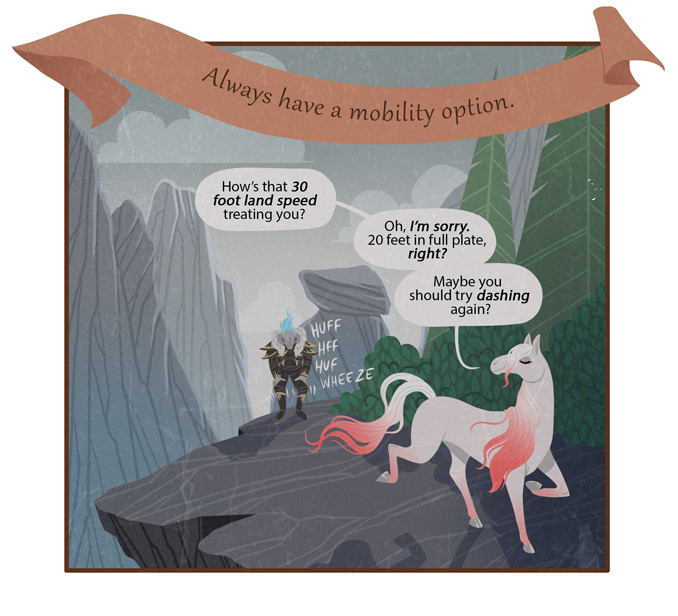


You know why the quick runner’s shirt was so popular? Because optimizers figured out an extra move action could be used for all sorts of interesting non-movement related shenanigans. But do you know why it was popular, even after the errata? Well if I’m being honest, it’s mostly because there aren’t a lot of competitively priced chest-slot items in PF1e. But do you know why else it was popular? Because chasing enemies around the battlefield sucks, that’s why.
As a melee dude, there is nothing more obnoxious than spending a turn moving 30 ft., throwing your dagger, and hoping your enemy is still in range for the smitin’ next round. That’s especially true because so many melee combatants are set up for stand-and-bang combat. When you’re finely tuned for high AC and ludicrous damage output, there isn’t a lot of mechanical juice left over for running around the battlefield.
There’s a reason that this problem tends to self-correct. Over in 5e, you get Action Surge for your dash-and-smack pleasure. Ditto Cunning Action. Ditto Fast Movement for the barbarians, Unarmored Movement for the monk, and I-have-a-horse for all our paladin pals (Vengeance’s plight notwithstanding). All are design solutions that can stave off the feels-bad of move-and-do-nothing.
Even so, I think it pays to keep some extra mobility in the golf bag. For example, I remember falling in love with expeditions retreat on my eldritch knight PC. Dude was all the time running around the battlefield and smacking high-priority targets. I had enough movement to climb battlements, reposition for the rogue, run for my life as necessary, and take out annoying archer/wizard/eldritch blasters as the need arose. No idea how optimized that was compared to standard warcaster/booming blade shenanigans, but I had a blast utilizing the whole map and all the terrain features.
So what say you, Handbook-World? How highly do you prioritize bonus movement? Are you begging your mage for haste and your item crafter for celestial armor? Is a personal carpet of flying at the top of the shopping list? Or do you tend to enjoy huffing and puffing after all the evil horses in your life? Tell us your tale of fast movement and slow PCs down in the comments!
JOIN THE HANDBOOK OF HEROES DISCORD! Do you want a place to game with your fellow Heroes? How about a magical land where you can post your dankest nerd memes, behold the finest in gamer dog and geek cats, or speculate baselessly on Handbook of Heroes plot developments? Then have I got a Discord Invite for you!

For me, it’s absolutely infuriating to play any pc who’s not at least one of good at range and fast, for the reason you outline: not interacting with tricksier combatants is frustrating. The one character who probably went most in the fast direction was a thief rogue 4/elk totem barbarian 5 of mine with mobile in 5e, an expert climber who could move 150 ft in a turn (195 whilst raging) and go up walls like a gecko. A favourite trick when facing melee enemies was to climb a wall out of their reach, anchor there with the climbers’ kit she always carried using Fast Hands, and then attack them whilst hanging safely out of reach.
I read “elk totem” and my brain thought, “But how does the elk stick to walls?” Derp.
I actually kind of miss this type of tactical problem. I play a lot of Pathfinder Society and you don’t see a lot of hard to reach ranged characters here. Maybe you need to spend a turn to get to them, but the only real counterexamples I can think of are flying enemies. And then, speed of movement isn’t the problem. Maybe it’s just practical considerations because the battle mats are only so big, and you can’t guarantee the party has good ranged options. Still, I do miss that tactical dimension.
One particularly egregious example: You’re catching up to a caravan. You’re in a desert. You’re attacked the moment they see you. Combat starts 10 feet away from the nearest enemy.
one reason why I like Barbarians is the movement bonus, current paladin is mounted warrior. I often do have some ranged cabability, but it’s less than optimal use so I’d prefer to get in melee as soon as possible, this should also work as cover from spell cadyets and more ranged proficient enemies, never mind that on horse I can charge more than most spells range.
I do tend to play mobile characters. Extra movement isn’t critical (though I’ll take it if it’s convenient to do so), but different types of movement (fly, climb, swim, teleport) are always nice, as are tricks for moving across difficult terrain without penalty, or for avoiding opportunity attacks when moving in combat. Had a character in a Dark Sun campaign who didn’t need a mount… out of combat, he could match a horse for pace, and outlast them on stamina. Generally not all that useful an ability, but fun, thematic.
I did have a much-loved 3.5e character whom I’ve mentioned here before… a giant lizardfolk from a monsters campaign. I didn’t consciously optimise for speed, but between race and class and some nice boots, he was horrifyingly quick. And I say horrifying, because when you’re a 120ft away on the other side of a 30ft chasm, you’d like to think you’re out of melee reach, right? Wrong… he *could* charge that distance, and because speed and strength synergise so well with jump in 3.5e, he could reliably clear the gap too. That was a fun character…
For games with battlemaps and miniatures I love me some highly maneuverable characters.
High-speed (and especially special movement types) are great fun, but only when it still allows for additional actions taken. I want to use it for seizing opportunities to go *do stuff* when the chance presents itself.
Running around enemy skeletons and grappling the necromancer when a gap opened for instance.
For the same reason Quick Runner’s Shirt where rather disappointing to me after the errata. Forbidding people from switching to a new one after use was perfectly reasonable, but losing your remaining actions mostly relegated it for running away (with a few exceptions for multi-turn approachs). I understand why they did it (a bit to easy way to move and full-attack especially on the small maps printed in PFS scenarios).
Say you where chasing an enemy around on the battlefield, you move and use your shirt and now you are standing next to them. Then what? You can’t do anything to them this turn, they can just tumble/withdraw away from you on their turn and you are back to square one. (There might be some exceptions if the terrain is favorable).
We typically house-ruled the mechanism for why you couldn’t just switch the item, since we didn’t like the aesthetics of people being forced to sleep in their magic items.
Man, Snowflake is a jerk. Vengeance is either going to have to rein her in (preferably with a sanctified bridle/saddle/whip) or she’ll be unemployed… Again.
Movement is definitely a big concern, but to me, in a good way : that means combat is more than just making a full attack every turn (which is why I liked the QRS errata). Are you going to move ? Do you use Vital Strike or Cleave ? Do you have a straight line to Run or Charge ? Those add variety to combat.
Of course, in terms of balance, that’s an issue with ranged attackers, ways to get pounce, and makes Haste excessively powerful (as if the rest of the bonus weren’t enough). Balance is rarely perfect, and can turn into an issue – even if conceptually, I would normally love something that encourages creativity.
Our longtime Game Night campaigns (long before me) involved a bunch of folks who bought the 3.0 rulebooks and decided that 3.5 was optional “whichever rules set works best.” My samurai campaign uses the Oriental Adventures rules (written for 3.0, then haphazardly patched for 3.5). That made it possible (and relatively easy) to have the competitively priced 3.0 version of the Boots of Striding and Springing that don’t ADD a puny bit to your movement but DOUBLE it instead. Slap a pair of those sneakers on a Monk, and it’s time to cue the theme music. https://www.youtube.com/watch?v=IQjpuzEuBvU
I prioritize having some kind of ranged option, when I’m not playing a ranged-by-default character. Which I usually am, because I find D&Derivatives’ spellcasting to be more compelling than its basic combat mechanics.
Anyways, yeah. Pathfinder doesn’t have many good shirts at low levels. The Endless Bandolier is handy if you’re using guns or similarly-sized weapons, the Vest of Shed Servitude is cool (if super situational), the Sipping Jacket sounds neat if you like using potions, but that one’s already five times as expensive as a Quick Runner’s Shirt. (5,000 gp) Some shirts are actually good for certain characters (the Cackling Hag’s Blouse is a standout), but most of them are painfully situational.
Part of me wonders if shirt-slot magic items are only included because the torso has so much space that otherwise wouldn’t be used by any magic items. But by the same token, there isn’t a pants slot. No greaves of the death knight or dungeoneer’s dungarees skirt of steak or chausses of situational AC bonuses. If you don’t buy ordinary clothes to wear under your magic items, you’re guaranteed to be half-naked. I forgot where I was going with this.
In my first 2e session, the party Barbarian and my Rogue got in a dispute – we’d defeated an enemy and the Barbarian wanted to kill them for their crimes against goblinkind while my Rogue wanted to haul them into town and hand them over to the police to get more information about what was going on and also because there was a reward out for their arrest. This eventually degraded into the Rogue picking up the enemy (a halfling) and running back to town with him while the Barbarian chasing after him with a 5 ft shorter land speed, slowly falling behind while demanding a Fortitude save or something as an endurance check.
Player tempers were actually a bit flared at the time, but it’s pretty funny in retrospect.
Careful, Snowflake. Looks like the night is waning fast.
Currently playing a Slayer, so as a sneak attack using character, movement is important to me. That is why, although I can use medium armor, I am sticking to light. That extra 10 feet can make the difference between flanking with an enemy or just being next to them. Sadly too low a level to get access to the fun extra movement options quite yet
In PF2, this is where I’d look to my allies to cover my bases. A kineticisr or someone with the Marshal archetype can basically launch me across the map, while the cleric can give me haste or a similar movement buff. In PF2, everyone’s a little weaker alone, and your typical melee combatant is likely to struggle without allies to cover her weak points. If you deliberately build towards versatility, of course, you can always grab an archetype to spec into movement or archery or the like!
In Baldur’s Gate 3, my melee characters have come to appreciate that you can jump as a bonus action. Grants just a bit more distance. Remains useful up until if/when you find the Boots of Speed (double movement for a bonus action).
Alternatively, the Dark Displacement Gloves can be a chaotic but fun way to close the distance with a group of enemies. With these gloves, a thrown weapon has a chance of forcing the target to swap positions with the attacker! 😀
Then you realize that Enhance Leap is a Ritual spell, and suddenly jumping becomes a massively more efficient way to move than basically anything else in the game if you can see the fight coming (or even not, after a while it’s well worth the level 1 spell slot).
Most rules are/were tailored to players expectations based on assumptions that weren’t necessarily true, like needing help getting into a saddle in armour, or drastically lowered mobility when wearing plate…arrows, bolts and spears sticking out of the holes they punched through light armour would tend to slow you down a little more methinks 😉
https://www.youtube.com/watch?v=qzTwBQniLSc
I’ve always liked mobility, in all games. D&D is not an exception.
In 5e specifically I feel that the 30ft base speed is so ubiquitous that any deviation, no matter how small, is significant. It’s not about how much faster or slower you are than the opponent, just that you are faster or slower in most cases. It’s for this reason I refuse to play a mall race, for example (unless I’m mounted, like my current dog-riding halfling paladin). 5ft less might not seem like that much of a loss, but in my experience, it IS. Past that, the most important mobility options are those that allow you to deal with obstacles and/or verticality, rather than pure speed. Misty Step for example is a fantastic spell, and for good reason.
Extra mobility is fine and dandy, but a melee guy who didn’t pack a ranged option has only himself to blame when he finds himself fighting an evil horse, or worse, a mage who just stays in the air above him firing off cantrips.
A ranged weapon drastically improves your relative movement rate, seeing that your opponent shrugs off magical arrows like rain means you get a head start when you turn and run 🙂
This is why you always carry a back up weapon. Your raging barbarian may be able to do a ton of damage on a charge with power attack & leap attack, but if the enemy is flying 15 feet above you, what are you going to do? Which is better? Doing 0 damage with your great axe or 1d8 with your longbow that you forgot about from your starting equipment?
If you’re an archer, carry at least a dagger. What are you going to do when you’re in the mountain pass and the GM describes the scene with gales of powerful wind? Sure you can sulk about your gimmick being defeated or you can move into flanking for the rogue.
I know it’s not as much a thing in 5E but tumble/acrobatics in 3.P was an amazing skill to get around the battlefield and avoid those pesky AoO’s.
Wait… Claire? Is this why you gave me side-eye when I suggested a very different kind of mount for Vengeance…?
One of the reasons I love 4E is the huge emphasis it places on mobility; shifting yourself, your allies, and your enemies around the battlefield is a natural complement to powers that differ slightly but significantly in the size and shape of their AOEs.
For a more recent example, my new Scion character only has 2 dots in Dex (human average, but well below what’s expected for a physically focused Scion), which tanks his movement speed. I’ve chosen to compensate by buying the Holy Bound knack, doubling my jump distance. Now he can leap 20 yards vertically (or a whopping 40 yards horizontally) as a diceless action and at the same time (albeit with a -2 penalty) grapple whatever enemy he just landed next to. Flying enemies won’t know what hit them.
I’m currently playing an Unchained Monk and a Nightgaunt came flying out of the mist and flew away with our bard back into the mist. To be fair my character was bogged down fighting a pair of ghouls and couldn’t have done much to help, but it didn’t help that I couldn’t reach them.
My take on movement is either ignore it or go all-in, if you care about it. Mages can just take their normal speed, skirmisher builds go all-in, and heavy builds go for “I don’t care; I’ll be mounted infantry.”
Mounted infantry being, they use a horse to get to the battle… then they dismount and don’t risk the horse, instead functioning as heavy infantry.
It looks like Vengeance could stand to go for the Mounted Infantry approach if that vampire horse would work with him. That said, not hating on the Cavalry build – it’s quite good if you know what to do – but that’s someone else’s movement speed in a fight.
In Pathfinder Wrath of the Righteous video game adaptation, they added a new subclass of Magus, Arcane Rider, that does not exist in the pen and paper version.
And I love it. Combined with a Racer-class horse and the Lightened Harness magic item, that’s a mount base speed of 80, meaning that you can do, in a single turn, a 160 feet movement, then cast a spell, and do a full attack. And if that’s not enough, it’s also possible to use a swift action to do a 30-ft. dimension door and get a free Haste effect as a bonus!
Pro: allows to explore the game at a comfortable speed.
Con: makes it feel insufferably slow when the game removes your mount, such as in non-combat areas.
Con: also causes the rest of the party to lag behind something fierce so combat tend to be a solo affair as the other party members just spend al their turns attempting to reach the battle site.
In my experience, no matter how much movement you have, there will always come a time when you need just 5 feet more.
Snowflake isn’t burning in the sunlight because would absolutely one of those Jergal-damned sparkly vampires
Snowflake isn’t burning in the sunlight because she would absolutely be one of those Jergal-damned sparkly vampires
-sorry, forgot a ton of tiny words. Blinded by undead-despising zeal
Travel Domain for the Cleric, Flame Mystery and Cinder Dance for the Oracle, Major Magic (Expeditios reSneak) 2/d for the Rogue.
I tend to play snipers or artillery; battlefield mobility is for the other guys
I made an-honest-to-God hobbit thief for a 1E campaign run in the Friday Night Gaming Group awhile ago. I managed to score a girdle of stone giant strength, so my little guy was dishing out that sweet, sweet, exceptional strength damage and throwing boulders. It was funny as Hell.
The next time I build a character like this, I’m gunning for a ring of jumping or boots of speed or boots of striding and leaping. Cause the image of a halfling speeding across the battlefield like the flash and slinging boulders is HILARIOUS.
This is why in Starfinder you invest in a jetpack at 5th level (once you can afford it) and then upgrade to a forcepack at 9th. Speaking from experience here. -_-
I had the opposite issue in my old Exalted 2nd game… damn our Scourge could run fast. Like Mach 5+ in water? Made NPCs trying to run away very difficult.