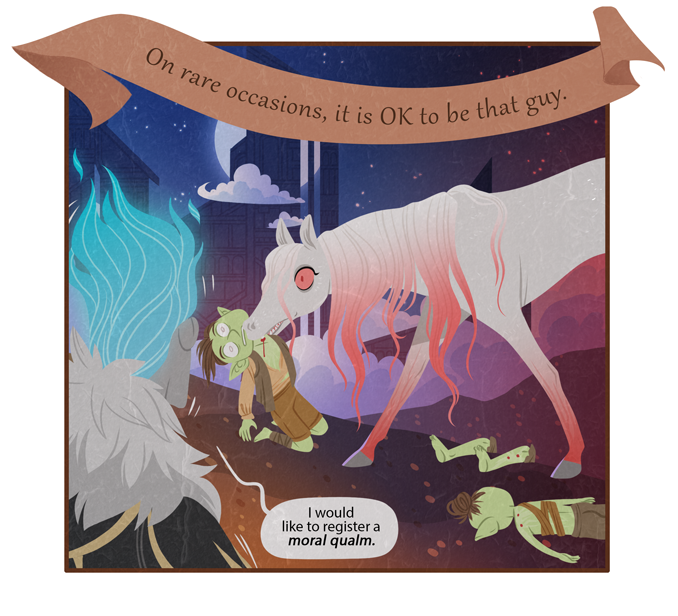


Could you imagine suddenly discovering that you’ve got a vampire in your midst? Just think about it! You’re a normal, run of the mill adventuring party. But there are signs you can’t ignore. Exsanguinated wildlife turns up around camp. Holy symbols go missing. And then you wake up in the middle of the night with some apparently-charming party member crouched over you like a sleep paralysis demon.
I know. It’s a completely innovative and original idea that I’ve discovered over here. But for me, what’s more interesting than the secretly-evil trope is what you do about it.
As the BG3 example shows, the story will fall all over itself in order to keep the bad guy with the party. Maybe they’re a vampire vegetarian and only eat critters. Maybe they’re racing against time for a cure. You need their help to survive some larger threat. You’re honor-bound to deliver them to The Holy Brotherhood of Slayers, and so you have to handcuff them to yourself for the time being. (Incidentally, that last one distinguishes itself by making the handcuffs literal.)
In all cases, we’re being narratively coerced into keeping the VERY BAD THING in our company. That’s good drama, but it is poor player agency. That’s because the real thing that’s keeping you from booting the loser is that fact that it’s your friend Jim is trying to play an evil character for a change, and that means you’re obliged to invent some excuse to go adventure with the character. We’ve been over this biz way back in the Mean Girls arc, but what do you say we take it a step further?
What would a character have to do to get booted from the party? How much evil are you willing to put up with before you bite the bullet and say, “Why the crap would my character allow that?” For today’s discussion, tell us all about the times you were most tempted to be “that guy” and risk the label of “lawful stupid” against a fellow party member. Tell us all your most serious in-character moral qualms down in the comments!
JOIN THE HANDBOOK OF HEROES DISCORD! Do you want a place to game with your fellow Heroes? How about a magical land where you can post your dankest nerd memes, behold the finest in gamer dog and geek cats, or speculate baselessly on Handbook of Heroes plot developments? Then have I got a Discord Invite for you!

I’ve had campaig s with evil characters go OKfor 200 sessions and some crash and burn on session zero. It depends on the evil. There are some workable party evils.
C.I.A. evil is “I am the monster who does the bad things thst must be done to protect good people”. This evil will shoot the hostage to complete the mission.
F&F-evil – kind of like CIA evil, this evil will protect those they care about (“family”) and don’t give a rats rear end for anyone else. As long as that’s the PCs, that’s generally workable but there will be a few revenge-fueled fires in the campaign.
The embezzler- the greedy one who knows how much they can skim off the top without irki g the others too much but also knows to give the glowy magic sword to the fighter and to suggest they smelt down evil idols before the paladin does (but with the intent to sell the gold ingots later).
The agreeable sociopath- think Fighter but less of a jerk. They are helpful, up for anything, and have no trouble killing anyone or anything if someone brings it up. They tend to be somewhat unmotivated, which limits their evil to occasional shocked moments of “What’s the big deal? I thought we didn’t like this guy!” Joe Pesci in Goodfellas before he goes rabid.
Jayne Cobb from Firefly is my go-to example of how an evil character can share a table with a good-to-neutral party and be an asset to the story and the game. By your breakdown, he’d probably be a superposition of “F&F evil” and “agreeable sociopath”. Although even then, he once very nearly got kicked from the party, and from existence altogether, over a disagreement on who counted as family…
He not only managed (except for That One Time) to remain an asset rather than a liability to the crew in-universe, but also found that narrative sweet spot where the audience (or in a TTRPG, the fellow players) might say “I don’t like this guy”, but never said “I don’t like the rest of the crew if they associate with this guy”.
That last distinction is the reason I don’t put up with players who insist that “it’s no one else’s business how I play my character, and we agreed to no PVP, so you can’t do anything about my crimes.” If you do atrocious things and then expect the others to have your back as a fellow player, that’s a form of PVP in itself. You’re giving their characters an involuntary moral lobotomy.
Jayne Cobb isn’t Evil. He’s greedy, shortsighted, and selfish, but isn’t Evil. Not by D&D standards anyway. He’d be a Neutral with a “bad attitude”, and he’s certainly no Good guy, but he also isn’t sacrificing virgins, murdering, or raping, so “Evil” is a stretch.
Aside from the one time he really screwed up, mostly he was a mildly dumb selfish jerkwad. And Jayne did have a bit of growth after his screw up, he learned what Loyalty means and what being loyal can bring you, despite not really changing who he was.
Nah, Jayne was evil. He killed his partner on Canton (chucked him off the ship to lighten the load *before* he tossed the loot) and shot his former employers when Mal offered him more money. That’s outside all the thievery and other paid killings Jayne had done.
Jayne was “agreeable sociopath” evil with a smidgen of conscience at the beginning. The Serenity crew encouraged that conscience so he might, maybe, have been LN towards the end of the series. I still put him in F&F evil though as I see him still reverting to evil when his “family” wasn’t around.
To heck with registering a moral qualm, Vengeance!
Smite. EVIL.
It is entirely justified.
I have been the source of evil in the party, but –to be fair– I had the DM’s blessing by that point and I was provoked. It was a pick-up group playing Sinister Secret of Saltmarsh and I’d been invited by the DM to come play with his regular group. (In the years since, I’ve suspected that the DM knew what might happen and was trying to teach his regular group a lesson.) My go-to AD&D 1e character was an Assassin. I’d pulled the whole “How do you do, fellow adventurers” routine and introduced myself as a Fighter/Thief. Honestly, all I wanted was my share of the treasure. If I didn’t have a contract on someone, then I was “off the clock.”
First time I go for another slice of pizza, the other players all look at my character sheet and read “Assassin” and determine that my alignment is evil (they weren’t much better) and I couldn’t be trusted. They metagame and whine, demand ridiculous in-game tests (an Assassin can function just fine as a Fighter/Thief), and complain when (alone) I find a single small gem in the stable and do not later report it to the rest of the party (which I still would have done as a Chaotic Neutral Thief, I point out).
When the mission is over, the party overwhelms my character, ties him up, and takes all of his possessions, claiming they are justified because he “stole” that gem. (I’d been hired to be a Thief, so the irony was not lost.) I quietly made the rolls to slip my bonds, Move Silently & Hide in Shadows, then rolled my Assassinate Percentage against all but one party member and slid the note to the DM.
He agreed.
The one guy who, all evening, had insisted that even if I WAS an Assassin, ESPECIALLY if I was an Assassin, I shouldn’t be provoked and kept pointing out that they were metagaming like madmen and had invited me to join in the first place, HIM I left alive with the other shares of the treasure and a note. https://clip.cafe/the-missouri-breaks-1976/logan-you-know-what-woke-up/
Forgive me, it’s been four days since my last confession.
The definitely-not-evil-honest Hexblade in the party used circle of death while we were breaking into a guardhouse and caught the dungeons in the 60ft radius, so a whole bunch of 4HP commoners got whammied for 8d6 necrotic each. When we found the heap of very fresh corpses, he was fine, but my Gunslinger was decidedly unhappy about the massive collateral damage and shot him. Nonlethally, which was slightly unfortunate when he returned fire with an eldritch blast to the face. We kinda called it a truce from there with a ‘please avoid splash damage or we’ll finish this’ agreement that lasted up until the player left the group and his character got whisked off to join the Blood War.
I once saw a Chaotic Good character do a similar thing with the spell Arbitrament ( https://aonprd.com/SpellDisplay.aspx?ItemName=Arbitrament ) which can kill chaotic evil, chaotic good, lawful evil or lawful good creatures that are 10 levels below the caster’s level. The character used it in the middle of a demon-controlled spa, not fully appreciating that many of the spa guests were low-level victims and not demonic accomplices.
The character DID feel bad about it afterwards, and so was allowed to remain Chaotic Good. Given that they were a demon-blooded tiefling, it wasn’t entirely illogical that their understanding of “good” was more focused on destroying bad than protecting good.
I was going to say that the bigger question is what blew that goblin’s legs off before Snowflake bit them (which would seem like the bigger moral question), but I now realize that it’s just folded over a ledge or something.
This plotline has been amusing to me, occurring as it has as I have been writing a vampire goats mini-adventure. The vampire goats are more obvious antagonists, however.
These sort of shenanigans are why, whenever I GM, I have as a rule that party members must be a somewhat compatible alignments. Any evil party member in a good(ish) party must have self control and not make life hard for the rest of the group. Any evil party cannot have a token good member constantly getting in the way of dastardly schemes unless tabletop Hazbin Hotel is what you’re gunning for….. (Actually that last one sounds like a fun idea)
I have been in a Star Wars game all jedi party where one player, playing an Ewok, was constantly going dark side and babysitting it to avoid trouble became an almost full time job for at least one party member. It did end up becoming a Sith Lord at the end.
On the other hand, I have played in a superhero/cyberpunk setting, a character that was a complete sociopath with no personal concept of morality. A Mystique type shapeshifter that was the party face and Mata Hari while the rest of the party were good guys (by cyberpunk standards) more classical super heroes.
The only people my character cared about was the rest of the party that she saw as her little brothers/sisters. Anyone else was fair game for lying/murder/exploit without a hint of remorse. She was however, very pragmatic and understood the value of PR so would fake morality for the public. She would also accept the party decision even if she disagreed with it so no committing atrocities behind the party back and what ones she would commit with permission, she would ensure nothing could trace back to them.
“These sort of shenanigans are why, whenever I GM, I have as a rule that party members must be a somewhat compatible alignments. ”
Last time I played in a campiagn of the D and the D we had a rule the whole party had to be within one step on the alignment chart of the Party Alignment, which was LE. We had a LE Cleric, NE Ranger/Fighter/Barb/Thief (me), NE Thief, LN Monk, N Bard, and a CE Wizard/Druid.
The CE guy didn’t last long, not because he was ‘chaotic” (he really wasn’t) but because we* we’re Oath Sworn to the Emperor and //f-ing fanatic// about it an he kept mouthing off about how “bad the Emperor of Mankind was”…
The Bard was our “sidekick/mascot” who was very “pie-in-sky” idealist (compared to the Evils in the party) and kept trying to “gollygee guys, can’t we just do this another way” us. It was cute and funny when we’d go out of our way to keep the reall bad stuff away from the Bard’s knowledge so she’d keep singing our praise and not know just how horrible some of the stuff we got up to was (the Player knew and thought the whole thing was funny too).
*The Cleric got his powers from the Emperor and my PC was the Cleric’s bodyguard and a fanatic Oath Sworn as well (got my Ranger powers from the Emperor).
Hmm… If having to put up with jerk players is “poor player agency,” I suspect that good player agency is less common than might be supposed. And this easily works both ways; the person who plays a Paladin (or other holier-than-thou character) because they enjoy the power to self-righteously say “no” to the other players is just as bad.
The last time I played a lawful evil character, I put the focus on the lawful part, and between that, and a commitment to be a team player, it worked out really well. My character dueled with the lawful good fighter for leadership, and it was only after they lost and had sworn fealty that they “realized” that no end point or escape clause had been set. But, evil or not, an agreement was an agreement. It turned into an interesting dynamic, with my character settling into the role of catspaw for things the LG character needed done, but couldn’t be seen to do themselves (including strongarming the other player characters…)
It came to a head when Mr. Goody-Two-Shoes fell into a chute trap and the rest of the party decided “good riddance,” and were going to leave them. My character was torn between having the chance to finally assert leadership and living up to their oath, but finally jumped down the chute. Both characters died down there in the depths, after having a “I always knew you were an a*****e, Gorman,” moment.
I was actually in this exact situation before. I was an extremely lawful Paladin, another party member ended up gettin turned into a vampire early on. I was… decidedly opposed on a fundamental level, despite said vampire not really doing anything evil. I was absolutely That Guy in the situation, sadly. Amusingly, of everyone in that game that I didn’t know beforehand, the vampire’s player is one of only two that I still talk to.
This reminds me of a 5e campaign I was in where our Bard/Paladin summoned a fiendish pegasus. However, he did NOT care for its safety and would routinely let it get mulched since “it deserved it”.
I haven’t had too much experience with this, but I do remember one of my favorite gags from running a game.
So, I was introducing a new player which just so happened to line up with one of my players calling the cops. So new player was the setting’s police force. In order to get a proper introduction, I asked the other three players for a brief physical description.
When it came to actually describing the characters to the new players, the quote was “a rather tall man that looks rather nerdy, a woman with an interesting choice of fashion and an impressive physique, and a man that’s wanted for fraud.”
For me, the rule is “don’t get caught”. As long as the other PCs don’t know the evil things you are doing, or you have plausible deniability, they have no reason to kick you out. And if your character has a reason to stay with the party, they have a reason to hide how evil they are.
It can be limiting in how evil you actually act, since most of your actions aren’t off-screen. Although, on the up side, the worst your “common enemy” is, and the longer you have spent with the party, the more you can get away with.
It also depends on how the party reacts. If you are with the “if they pings to Detect Evil, we can’t work together” type, someone will have to relent.
Actually the BG3 example fails. I killed Asterion when he tried to bite me and the plot didn’t stop me. People complained after, but I draw the line at snacking on the party.
I haven’t played BG3. Why is that character cosplaying as darth maul?
The person you’re (presumably) talking about — the one with the straight hair and elaborate makeup — is the PC, so they look like that because the player said so on the character creation screen. The curly-haired elf who is biting them is a vampire NPC named Astarion who, right up until the moment shown, thought he was doing a fiendishly clever job of pretending not to be a vampire.
“I’m a perfectly ordinary elf with red eyes, sharp teeth, an effect and overly formal manner of speech, and two puncture scars in my neck that I never bother to conceal. On an unrelated note, allow me to offer a half dozen frantic and implausible explanations for that exsanguinated boar you just found, even though you didn’t even mention that you found it strange.”
“effect” -> “effete”. Bad autocorrect.
Well, the short, glib answer would be “at whatever point *their* player acknowledges that their character no longer fits with the party”. Prior to that point, forcing the matter will just result in PVP, with no guarantee of a successful resolution.
And yeah, it’s a little glib, but it’s also worked for me a few different times. Twice in my first campaign of Scion, once with my roommate’s PC Sevgard going totally off the rails and becoming an agent of Fate and antagonist when he decided “yeah, this guy is too chaotic and has burned too many bridges to stay with the party”. And once with my PC because the party had swung increasingly evil and my Gallant Scion with a geas compelling him to defend the weak was becoming more and more of a problem for group cohesion, so I asked the Storyteller if he could go out in a blaze of glory and rolled a new more evil character (funnily enough, he and GM-controlled Sevgard took each other out). The third case was a game of Numenara, where one of the party members stole from my PC (so far so forgivable) and then tried to get away with it by projecting horrifying images into Locus’s mind to stun him and make good an escape. Having initiated PVP, and having crossed the line with the mental images he sent, everyone (him included) agreed it was fair that Locus retaliate when he got a nat 20 on the saving throw. (One round later, Locus was scooping the offender’s unconscious slime body into a pickle jar, where he remained for the rest of Locus’ natural life, and possibly got passed down through the generations as the world’s worst inheritance).
But this also lets you play around with things a bit. What if the offending character thinks their crime is much worse than the rest of the party does? Do you want to track them down, and say “no really, it’s fine that you’re siphoning a little of my blood because you need it to survive” (or other character-specific thing)? Going back to my example from… last week(?), of my new Scion character Alexandra the monster hunter and her Guide/love interest Mara Secare (secretly a monster herself), one of the ways I can see Mara’s secret getting spilled is having to switch to her combat form in order to save Alex’s life, and then flees into the night once her love is safe. Alex then has to go through some dramatic soul-searching before deciding whether to track Mara down, and what she’s going to do if she finds her.
Our current party has fairly minimal problems with this issue, mainly because we’re a bunch of pirates with big ambitions (profit, fame, adventure, etc…).
So long as you’re doing your job well, don’t mind being involved in piracy (and its less ethical practices), and don’t outright betray/backstab the crew or captain, you’re likely to be hired/press-ganged/welcomed to the crew.
That, or we just kill you and steal your stuff. Our captain is Calistrian, for whom bloody revenge is religious practice, so particularly egregious offenders don’t get off easily.
I accidentally did this once. It was a post apocalyptic setting, and my character was an assassin and a mercenary. I thought the game would be much more morally grey and bloody. Nope!
No one called me on it, but I wasn’t having fun, and felt like my character with her kill first, ask questions never, attitude wasn’t fitting in with the setting and party, so I retired the character and made a new one. I can’t really remember what exactly was the breaking point in that situation. I think it was after another argument with the party about what to do next.
“How much evil are you willing to put up with before you bite the bullet and say, “Why the crap would my character allow that?””
Depends on the campaign. It doesn’t even have to be Evil. Sometimes someone is too “Good” for the party. Sometimes one PC’s goals do not aligned with the groups.
Usually what I try to do as a Player (and as a GM) is have some convos as I see things are heading in the “it’s time to kick that person out” direction.
But that also depends on the type of game. A LARP for instance with over a hundred Players? i never bother trying to track that sort of issue, it usually resolves itself.
I have never kicked a player for evil actions in game. Only for being an AH in real life. I don’t allow evil players in any of my main campaigns and of course everyone is evil in my evil campaigns, it’s expected for the characters to watch their back around the other characters in the evil campaign.
My big peeve, which is why the no evil rule, is players that get their jollies out of fucking with the other players characters. If they start doing that, then there are immediate in game consequences. The players know the “leave the party members alone” rule before we start and usually the ones who would be an issue, leave when they find out about it. The other players will usually step in and shut down that behavior in game.
We rarely have evil characters — but my view is that they’re fine as long as they’re not played in such a way as to create out-of-character conflict… a policy which of course applies as much to the paladin as to the assassin. Work as a team, and if your character is secretly planning on betraying everyone, at least be open about it at an out-of-character level… that rarely comes as a welcome surprise, but can be a lot of fun if the players all know it’s coming.
Just wanted to mention that The Order of the Stick did a great arc on this when the dwarven cleric Durkon got killed by a vampire and raised as a thrall. As such he was completely under the control of the vampire until the vampire was later killed. Durkon then had agency and the party took him back in. Like BG3, they even donated blood to keep him going.
But secretly, Durkon was being controlled by an evil spirit with access to all Durkons memories and was only pretending to be good in order to carry the evil scheme of his god.
It was a massive twist and created a lot of tension in the story since we, the audience, knew he was evil and were waiting for him to reveal his true nature.
I am not sure it “counts” exactly, but in my last campaign I played a Forgeborn (Warforged with a better “race” name… purely a table change, but also in universe alteration to our setting) and every time we entered combat (roll for initiative) I had a chance of basically turning into a rage monster (not just attack the nearest thing, but definitely limited options, no class skills, just ‘Assess Threat -> Attack Threat’). It was a neat mechanic that I worked out with our DM and the players found it interesting… but it also left a door open that the DM walked through!
Behind the scenes, our DM came up with a backstory for me (I went with the cliched amnesia backstory so I didn’t have to come up with one and let the DM do whatever he wanted to… and wow did he!). Apparently my character was built to be a walking phylactery for a lich that was trying to be both “alive” and dead/immortal at the same time, but because I was literally built for war, my “default programing” was something that would take over in case of threat… and when the lich performed its ritual to become a part of my character, it got stuck in a sort of astral prison inside of me and over the next thousand years, whenever my combat skill would increase the lich would learn ways to take control and then go on a mad rampage until it was taken down and I would “reset”… All class levels gone again, back to level 1, new class, who dis. (All this info came out mostly post game except for the lich being in me and being stuck in an astral prison… where I fought him for total control over myself!)
What this obviously led to (when the DM privately informed me the first time it happened), was I got to play two characters in one. The character I originally started with, and the lich who was trying to figure out a way to “free itself”.
The reason the lich wouldn’t leave the party was easy: assess them, see if they can help or will be a hindrance, and use them until they are no longer useful.
The reason the party kept me along was because they didn’t know what was wrong with me. All they knew for sure is something went wrong when I entered combat sometimes, and I would swap from being a relatively capable monk to being some kind of spellcaster that only cast cantrips (the mechanical idea being the lich is a wizard without access to its spell memorization, so I could only use cantrips… which I did try to make “look” like they were weird monk abilities as flavor!)
This worked until the group decided that my skill set swapping was important enough to figure out what was wrong and “fix it” (so that I wouldn’t randomly swap to a kind of weak mage in the wrong fight), then the lich tried to flee once it took control again and we had a whole thing and a fight inside my own head! (I love RPGs)
—
Side note: I sort of did it again and only recently (two sessions ago as of this posting) revealed that I was a changeling instead of a halfling.
This might not seem like that big of a deal, and for the most part it wasn’t, other than the “shock” of the reveal at the table and to a group that in universe has been together for over 2 years now (our table group has been together for over 4 years now! They were also shocked to know the truth of my character’s “race”/”species”/whatever-term-is-socially-acceptable).
The “problem” was that this character has an in game husband and that player was a bit more than shocked to find out the person they had one thought of was not who they thought it was…
We had a LOT of talk about things after this session, I have talked to other people in general about the situation, and generally, everything is okay, but I will say this much about secrets and playing “evil” (even if you aren’t doing actual “evil”)… make sure there is TRUST in your group and people are prepared for a “switcharoo” if that is the plan.
side side note: our group did talk about things and my in real life player friend is absolutely fine with things now, but in the moment, she was thrown for a loop and didn’t feel good about it. (And as for my in game husband… yeah, that is going to take a lot longer to work through.)
I once had a player who would consistently attempt to rape any young female NPC he came across, despite multiple warnings that I’m not going to tolerate such behavior. Twenty-ish years of GMing and to this day he’s still the only person I’ve ever booted from my table.
I already killed our Dark Urge player when he ended up agroing karlach.
I had made it very clear that she was not to be touched and he had already pushed the limit by dooming Wyl, which karlach was not taking well.
I was tempted to reload before he committed to dooming Wyl, but for the sake of the other players I compromised at save scumming until he could trick karlach into sticking with us a bit longer so we could continue the game.
It wasn’t me, but one of my groups had a character that was secretly a chromatic dragon that was polymorphed. Sadly I missed the session where he revealed himself, but he stabbed our Fighter to death that day. (We revived him, we had a ton of spare gold.) Eventually we killed the character but a warforged NPC that had been killed earlier was brought back to life as a minor deity. He proceeded to revive said dragon for the sole purpose of killing him again.
Most of the time I don’t have a problem with it. In reality, we’re surrounded by unspeakable evils all the time, and if you do something about it, it’s a great way to cast Summon Cops.
Also. Have you spent time actually researching the ‘evil’ villains of various RPG’s? Most of them are about as actually evil as larp’ing satanists (apologies to anyone who fits that description BUT YOU REALLY DO KNOW)